There’s a certain kind of freedom that comes with not spending on ads. No dashboards to obsess over. No rising Customer Acquisition Cost [CAC] to worry about. No panic when performance dips overnight. But more importantly, there’s something else you gain - something most teams miss when they rely on paid acquisition.
You build momentum.
The kind that doesn’t disappear when you stop spending.
Most businesses think of lead generation as a volume problem. More traffic, more leads. But in practice, it rarely works that way. You can drive thousands of visitors and still walk away with nothing meaningful. Because lead generation isn’t a traffic problem. It’s a trust problem.
A visitor is just a number,and a lead is someone curious. A real opportunity is someone who already believes you can help them - even before they speak to you. That’s the shift this approach is built on.
Why Most “Free Lead Generation” Advice Falls Apart
You’ve seen the lists. Endless tactics. Post more. Comment more. Send messages. Try everything. The issue isn’t that these tactics are wrong. It’s that they’re disconnected. When you treat lead generation as a checklist, you end up doing a lot - without building anything. What actually works is slower, and more deliberate.
You don’t try to capture attention. You earn it.
You don’t push for leads. You become someone worth reaching out to.
And once that starts happening, everything compounds.
The Core Idea: Stop trying to generate leads. Start trying to be the most useful person your audience comes across. If you consistently solve small problems in public, people begin to trust you with bigger ones in private. Leads don’t come from tactics. They follow usefulness.
The Strategies That Actually Work
1. Content That Builds Trust, Not Just Traffic
Most content is written to be discovered. Very little is written to be remembered.
That’s the difference.
If your content could have been written by anyone, it will be ignored like everything else. But when you write from experience - what worked, what failed, what surprised you - it does something different. It makes people pause
.
Instead of writing broad advice, write specifics.
Write what you tried.
Write what broke.
Write what you would do differently.
That’s what positions you as someone who has done the work - not just someone talking about it. Over time, this kind of content becomes a quiet engine for inbound leads. Not because it ranks alone, but because it builds credibility.
2. Communities as Your First Distribution Channel
Every market has its own gathering spaces. Places where people ask questions, share frustrations, and look for clarity. Most people show up there to promote. That’s why it doesn’t work.
The few who show up to genuinely help stand out immediately.
When you answer questions without redirecting to your product, when you share insight without holding anything back, something shifts. People start remembering your name. Later, when they need what you offer, they don’t search. They reach out. This is not instant. But it is reliable.
3. Partnerships That Expand Reach Without Spend
There are always other businesses speaking to the same audience as you.
Not competitors. Complements.
When you collaborate with them, you borrow trust instead of building it from scratch.
A simple co-created piece of content, a shared session, or even a thoughtful referral loop can open doors that cold outreach never will.
The key is simplicity.
You don’t need elaborate campaigns. You need alignment.
When two teams solve adjacent problems for the same audience, working together feels natural - and converts naturally.
4. Email as an Owned Channel
Social platforms are unpredictable. What works today may disappear tomorrow.
Email is different.
It’s quieter. More direct. More intentional.
But it only works when you treat it with respect. People don’t subscribe for updates. They subscribe for value. So instead of building a list for the sake of it, focus on giving people a reason to stay.
Share what you’re learning.
Share what you’re seeing.
Share things that make their work easier.
Over time, this becomes a space where trust deepens. And when someone is ready to move forward, they don’t need convincing.
5. Letting People Experience What You Do
Nothing builds confidence like experience. If you have a product, letting people use it - even in a limited way - changes the conversation entirely. If you offer services, the equivalent is showing your thinking.
Not a sales call disguised as help, but something genuinely useful. A walkthrough, a breakdown, a perspective they can apply immediately.
When someone walks away having learned something meaningful, they don’t forget you.
And when the need becomes real, they come back.
6. Outreach That Feels Like a Conversation
Cold outreach gets dismissed because most of it feels automated.
But thoughtful outreach still works - especially when it doesn’t feel like outreach at all.
The difference is intent.
Instead of reaching out to pitch, reach out because you’ve noticed something worth discussing.
Keep it simple. Keep it specific.
A small number of meaningful conversations is far more valuable than a large number of ignored messages.
And over time, these conversations compound into relationships.
Tools That Help Without Becoming the Focus
Tools are useful, but they are not the strategy.
Used well, they simply make the process smoother.
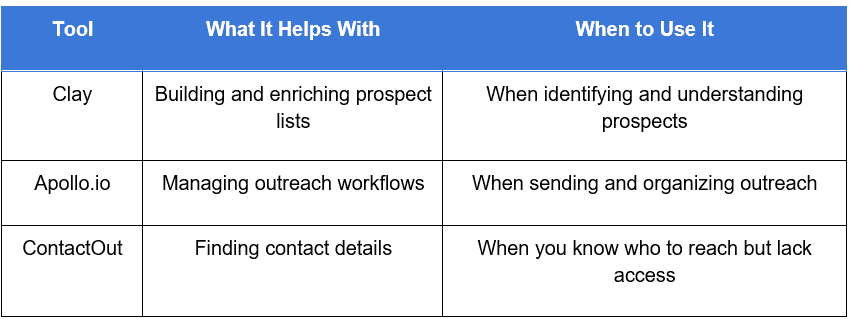
The goal isn’t to depend on tools. It’s to use them just enough to support what you’re already doing.
The Lean Lead Generation Framework
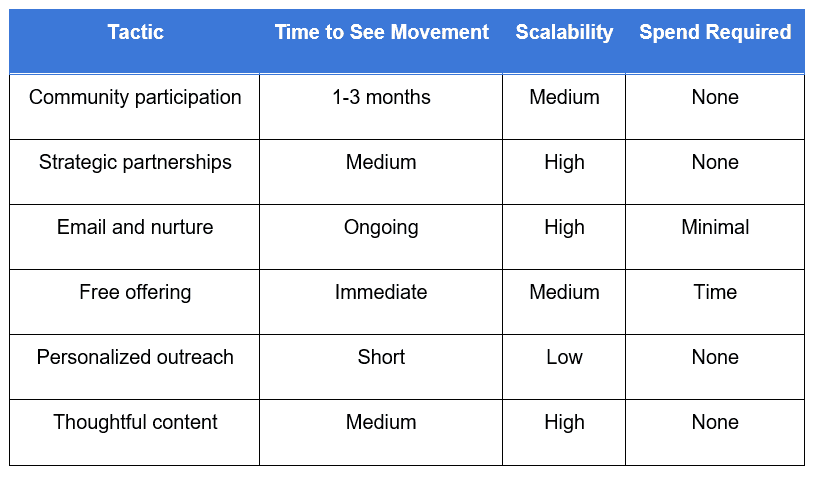
Where to Begin
The mistake most teams make is trying to do everything at once.
That spreads effort thin and results thinner.
Instead, pick one path.
Commit to it long enough to see patterns.
If you’re starting from scratch, conversations matter most.
If you have some traction, partnerships unlock growth.
If you’re looking to stabilize, your audience becomes the priority.
Everything else can follow.
The Bigger Picture
There’s a reason this approach feels slower at the start.
Because you’re not renting attention. You’re building it.
While others depend on constant spend to stay visible, you’re creating something that stays with people — your perspective, your voice, your way of solving problems.
Given enough time, that becomes difficult to compete with.
Not because it’s complex.
But because it’s consistent.
And consistency, in this space, compounds quietly.