In 2025, a 14-year-old named Vaibhav Suryavanshi walked out in the IPL and hit the fastest century the tournament had ever seen from an Indian, and one of the fastest from anyone. By the next morning every broadcast was asking the same thing: where did this kid come from?
He didn't come from nowhere. He came from age-group logs, trial sheets, and academy reports; things people had written down, in plain English, long before the rest of us had a name to put to them. The talent wasn't hidden. The signal was just sitting in a database, un-aggregated, waiting for enough people to notice the same thing at the same time.
Bumrah is the older, blunter version of that story. Before the IPL deal, before the No. 1 Test ranking, he was an awkward seamer: short run-up, wrong-footed load, a wrist angle no coaching manual would sign off on. Most people in the stands might have filed him under "interesting, but the action's wrong." A few wrote down what they actually saw, an unreadable release and yorker control that didn't make sense for his age. Those notes turned out to be right. For a long time, nobody read them next to each other.
If you run a talent pathway, sit on a selection committee, or own a franchise, here's the part worth sitting with: you are almost certainly already paying scouts who have already seen the next one. The problem is rarely that nobody watched. It's that eight people watched on eight different days, wrote eight different notes, filed them in eight different places, and nobody ever laid the eight side by side.
That last step: pulling the notes together, comparing them, surfacing what they add up to; is the part computers are genuinely good at. That's what this piece is about.
What this won't claim
No algorithm can watch a teenager bowl and tell you he's a future Test star. Nothing can; not a model, not a room full of legends. Predicting a career just isn't a thing any talent system can honestly do, with or without a machine in the loop.
What it can do is shrink the gap between the moment a scout first notices something and the moment a decision-maker actually acts on it. The rest of this is about how, in concrete terms, because we've built it.
Why the good ones slip through
You know the romantic version already. Pathways reward players who fit the template - tall quicks who move it away, top-order bats who play straight, leggies who give it air. The odd ones drift through the gaps.
The operational version is less poetic and probably more useful.
A scout at a Vijay Hazare game sees one innings, maybe two. A selector at U-19 trials sees one format, one standard of opposition, one afternoon. Every report is a snapshot of a single point in time.
And the thing you most want to know: is this player getting better, and how fast; doesn't live in any single match. It only exists across time, which means no one observer can ever see it. It's structurally invisible to the person holding the clipboard.
Then there's filing. A conscientious scout in Haryana writes up what he saw and drives to the next fixture. His report is now, for practical purposes, gone. It's in a format nobody else uses, in a folder nobody else opens, and it never gets held up against the seven other reports on the same boy.
Worst of all, nobody computes consensus. When five scouts who've never met all describe a player as "hard to pick up," that agreement is about the strongest signal scouting produces. Today it evaporates the second those five reports get filed apart.
So the bottleneck isn't talent, or effort, or even scouting skill. It's bandwidth and memory. No human can hold thousands of observations across dozens of competitions and several seasons in their head and compare them honestly. Nobody can.
What "AI" actually means here
Most write-ups gesture at "pattern recognition" and keep walking. It's worth being more specific than that. This isn't one model that spits out a yes or a no. It's a pipeline that takes scattered human observations and turns them into a structured, searchable, explainable body of evidence. Five stages:
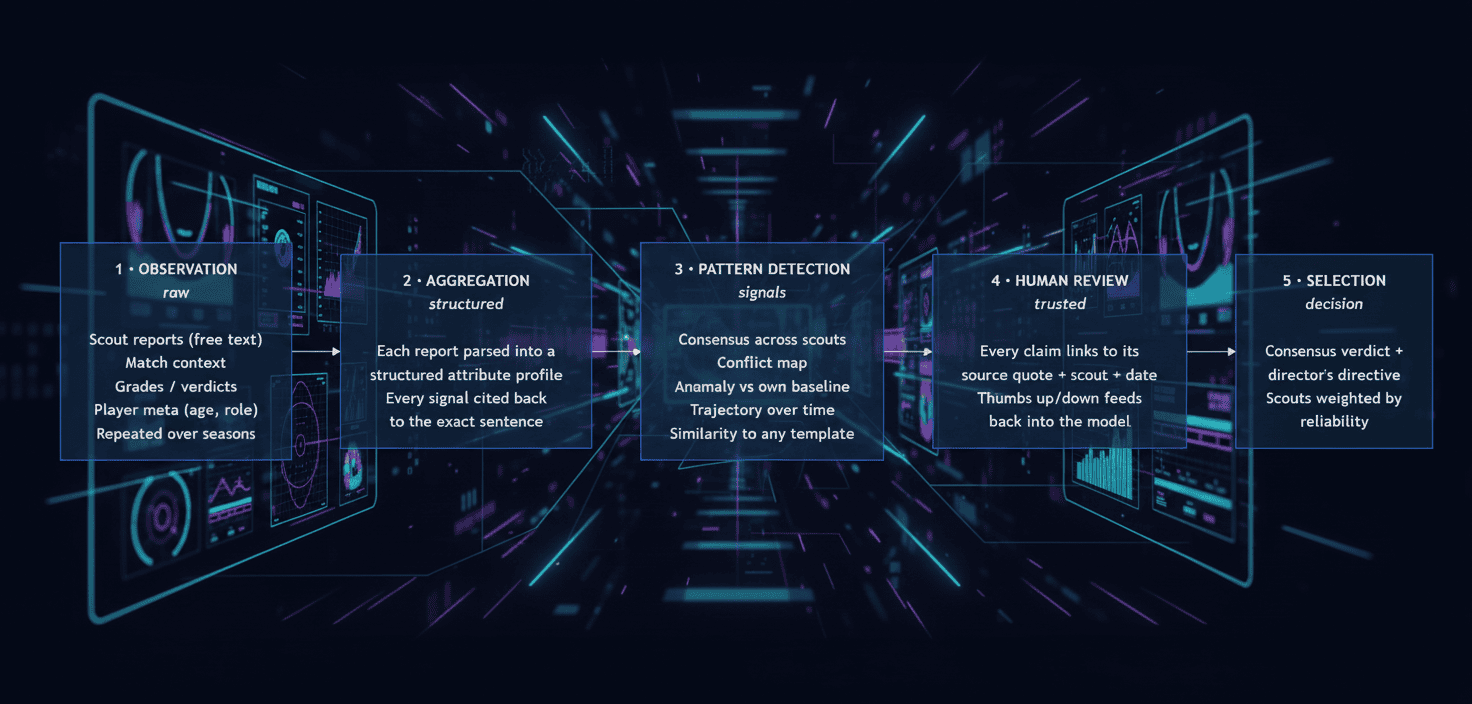
Let's walk it through with a cricket head on.
Stage 1: Observation: what goes in
The fuel isn't video, and it isn't biomechanics, at least not mainly. It's the thing your organisation already produces in volume and then quietly throws away: the written scouting note.
That means scout reports as free text - "deceptive release, looks gentle off the hand but on you quicker than you expect; control dropped in the second spell." It means a verdict attached to each report, on a fixed scale like Select / Squad / Track / Pass, so every note carries a decision and not just description. It means the basic metadata: age, age-group, role, team, standard of opposition. Match context where you have it. And, above all, the same player is seen again and again across a season and across seasons, because that repetition is what makes trajectory computable down the line.
The important design choice is that the system is built to swallow the mess: different scouts, different vocabularies, different levels of detail. It does not need a clean, pre-formatted dataset. Ask scouts to fill in perfect forms and you'll lose half your scouts before you've started.
Stage 2: Aggregation: prose into structure, without losing the prose
This is where most of the actual engineering lives. Each free-text report gets parsed - by a language model working against a fixed evaluation framework - into a structured profile across technical, tactical, physical, temperament, and role-specific attributes, each split into sub-skills with both positive and negative signals.
"Deceptive release, on you quicker than you expect" → Technical · Release deception → positive.
"Control dropped in the second spell" → Technical · Sustained accuracy → negative.
Two things keep this from being a black box, and neither is optional.
First, every extracted signal points back to where it came from. The system fingerprints each observation so the structured profile never floats free of the sentence that produced it, the scout who wrote that sentence, and the date. Nothing is ever "the AI's opinion." Every dot on the profile traces to a human who wrote something down.
Second, each report gets checked on the way in. Before a note becomes evidence, the system scores how complete it is, flags internal contradictions (calling a player "elite temperament" and "visibly rattled" in the same paragraph), runs a tone and bias check, and asks whether the observations are even relevant to the player's role. A thin or self-contradicting report doesn't get silently averaged in with a strong one.
By the end of this stage, eight inconsistent prose reports about one bowler have become a single structured, cited, quality-weighted profile; and you can still click any line and read the sentence it came from.
Stage 3: Pattern Detection: the five things no one can do by hand
This is the payload. Five kinds of pattern, none of which any single reviewer has the bandwidth to compute across a full database.
Consensus across independent scouts. When several scouts who never compared notes land on the same attribute, the system flags it and counts the agreement. This is the Bumrah signal. "Hard to pick up" showing up independently nine times is worth more than any one glowing review.
Conflict mapping. Where scouts disagree, the system doesn't average the disagreement out of existence. It puts it on the table as a matrix (below). Disagreement is information, and it's especially loud around unorthodox players.
Anomaly against the player's own baseline. A note that breaks from what scouts have always said about this player: "normally ice-cold in tight finishes; froze today" - gets flagged with what it might mean, instead of disappearing into the pile.
Trajectory over time. Positive and negative signals get plotted across the player's full report history. "Lacked control" reads very differently once the trend line shows control tightening season on season.
Similarity to a reference profile. Every player becomes a comparable vector of attributes, so you can take any template: a known great, an ideal role spec, the player you just lost - and rank your entire scouted database by resemblance. This is the "already in your database" engine, and it gets its own section below.
Stage 4: Human Review: the scout still runs the show
None of this takes the human out. If anything it does the reverse - it hands the human better material to judge.
Everything is explainable. A selector can take any flagged attribute and drill straight down to the source quote, the scout, and the date behind it. No recommendation arrives from nowhere.
And there's a feedback loop. Reviewers mark each signal relevant or irrelevant with a simple thumbs up or down, and that judgment feeds back to sharpen the system. The experienced people teach it. It doesn't overrule them.
Stage 5: Selection: the evidence, weighed and summarised
Decision-makers don't see one scout's grade. They see the distribution - how many independent observers said Select to squad versus Track - with the evidence sitting behind each. On top of that the system synthesises the whole picture into a single director-level recommendation, written as something a Head of Talent can argue with, not a score to obey. And because scouts have a measurable track record over time, the more consistent observers carry more weight. In effect, the system also keeps a performance record on your scouting network itself.
"Already in your database," made real
This is the part that should change how a committee or a franchise thinks about its own data.
Once every player is a structured, comparable profile, finding "the next X" stops being a search of the whole world and becomes a query against your own records. You hand the system a reference, and it ranks everyone you've already scouted by how closely they resemble it - controlling for age and role, so you're comparing like with like.
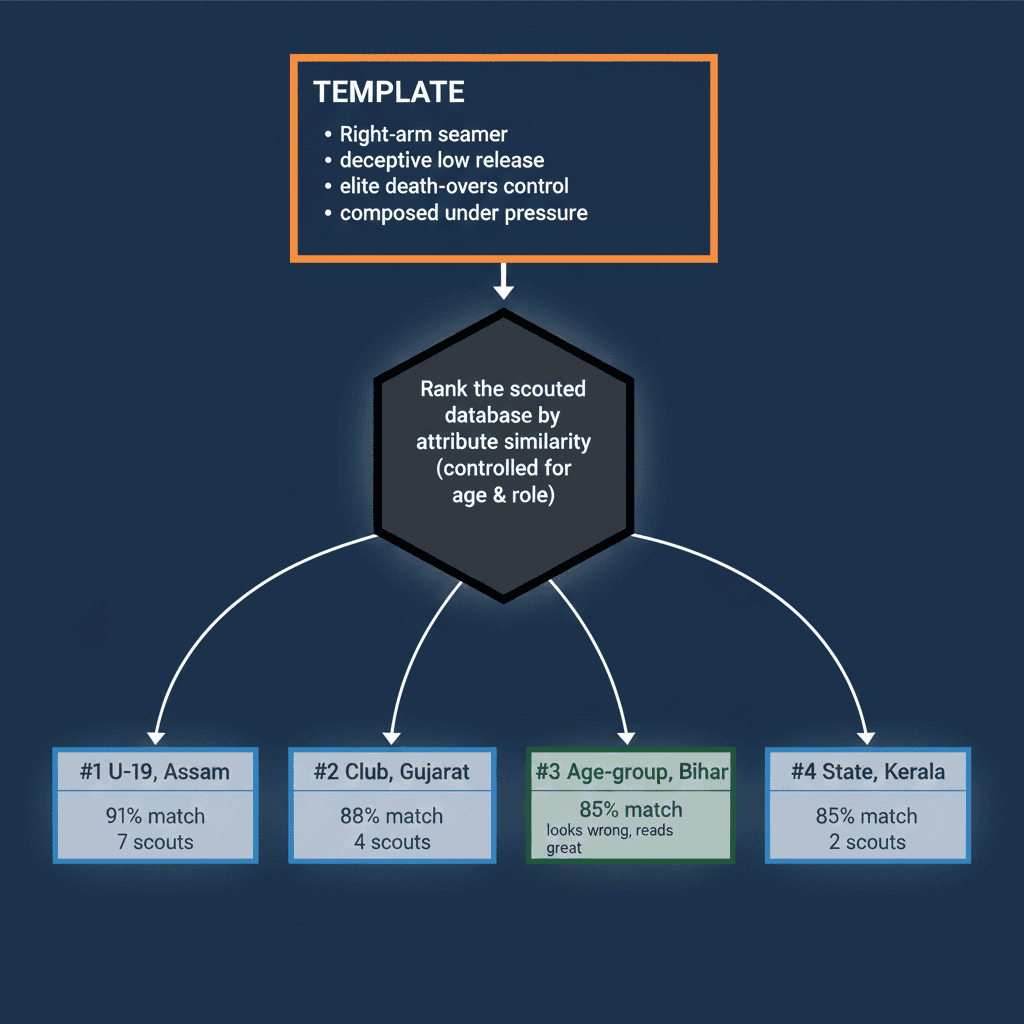
You can also just ask it in plain language - "U-19 left-arm seamers with an unusual action and improving control" - and get back a ranked, evidence-backed shortlist, each name annotated with why it matched and how many scouts stand behind it.
Run a young Bumrah through this and he throws a Bowler-A-style consensus flag years before the auction makes him obvious to everyone else. Not because the machine can see the future. Because it never lets nine quiet, correct observations stay scattered.
A worked example
Three young quicks, watched across one 18-month domestic season. Same raw notes a human would read, but with the pattern pulled out alongside them:
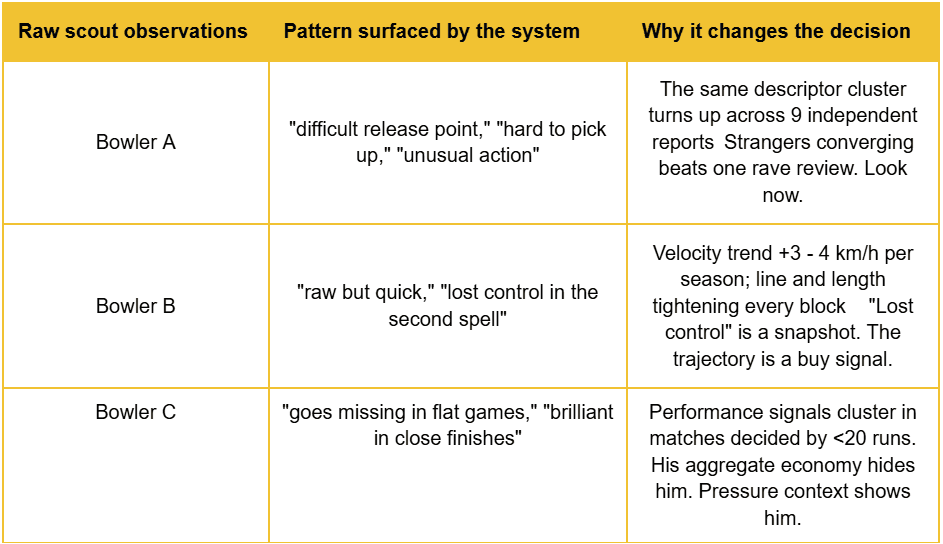
Notice that none of this selects anyone. Each one just earns a player a longer, better-aimed look - which is the whole job of talent infrastructure.
Spotting potential is not predicting a career
People blur these two constantly, and the difference really matters.
Identifying talent means recognising that a player has earned more investment, more coaching attention, or a serious look from selectors, on the basis of the evidence so far and how it's moving. It's an argument, built from observations, not a prediction. And the next Bumrah is almost by definition someone the early consensus reads wrong; which is exactly why the most valuable thing a system can do is refuse to harden consensus too soon, and keep the dissenting, awkward, unorthodox signal in view.
Bias, uncertainty, and the trap of false confidence
An honest system has to admit something up front: it inherits whatever bias is in the data it's fed.
Taller bowlers have always drawn more generous pace assessments at the same actual speed. Players from the big-name academies carry a credibility premium. The ones who "look the part" get written up more kindly. Feed all that into a naive model and it will launder the bias into output that looks objective; which is worse than the original bias, because now it's wearing a lab coat.
That's why the checks in Stages 2 and 3 aren't decoration. The per-report tone and bias check flags loaded language before it ever becomes evidence. And conflict gets surfaced rather than smoothed over. When scouts split hard on a player, the system shows you the split as a live matrix, because that split is so often exactly where the unorthodox talent is hiding:
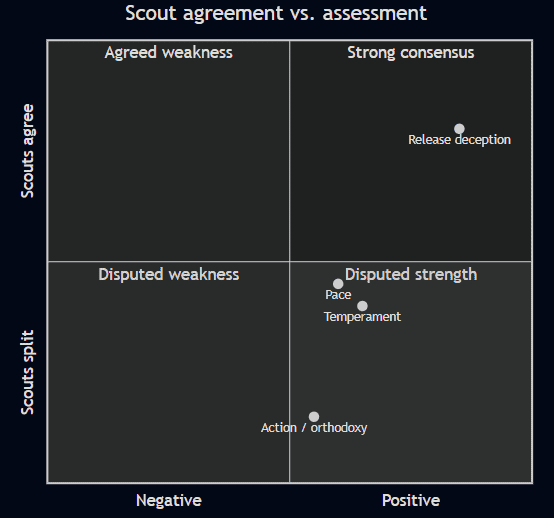
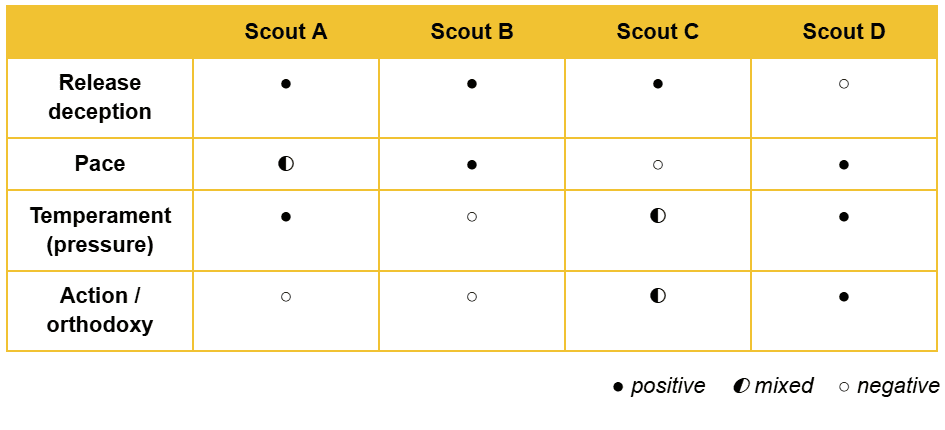
Flatten that bottom row into a tidy "average" and you'd erase the precise debate a selector ought to be having. The point isn't to manufacture confidence. It's to make the uncertainty visible so people can argue about it properly.
Explainability is the whole game
A recommendation you can't explain won't be trusted, and honestly it shouldn't be; these decisions hand out careers, money, and opportunity.
So every signal in the system is auditable back to its source. Flag a player for "deceptive release" and a coach can click straight through to the four sentences, from four named scouts, on four dated reports, that produced the flag. Then the experienced cricket people get to do what they're actually paid for: challenge it, put it in context, overrule it if they think it's wrong. The aim was never to replace their judgment. It's to put better evidence in front of that judgment, faster.
What this looks like from where you sit
If you're on a selection committee, the question shifts. You stop asking "which bowlers do we know about?" - which is really a question about who's well-connected - and start asking "which bowlers, across everything we've watched recently, show this combination of qualities?" The answer comes back grounded in evidence rather than familiarity.
If you run an academy or a state pathway, no scout's note dies on filing anymore. That diligent volunteer's report from Assam gets collated with seven others and surfaced the moment a pattern forms.
And if you run a franchise, your historical scouting spend turns into a compounding asset. Every report you've ever filed stays live, comparable, and queryable against any template you can describe - including the player you just lost and need to replace like-for-like.
The point was never omniscience
Somewhere in the BCCI's age-group logs, or an IPL franchise's barely-watched trial footage, or a report filed by an overstretched club volunteer, there's a set of observations about a player who doesn't yet look like an international. The notes probably contradict each other. Some scouts rated him; others clocked the odd action and moved on. And the trajectory, across two or three seasons, may already be showing what no single match ever could.
That player doesn't need a machine to make the call for him. He needs a system that makes sure the people who already noticed something get heard - their notes pulled together, compared honestly, weighed against everything else on file, and put in front of someone with the authority to act, before the rest of the world catches up.
That's the real promise of this stuff in cricket. Not prophecy. Just making sure the right observations stop going quiet.
The technology already exists. The scouting reports already exist. The question is whether they're being connected in a way that helps people make better decisions. If you'd like to explore what that could look like for your organization, we'd be happy to talk.