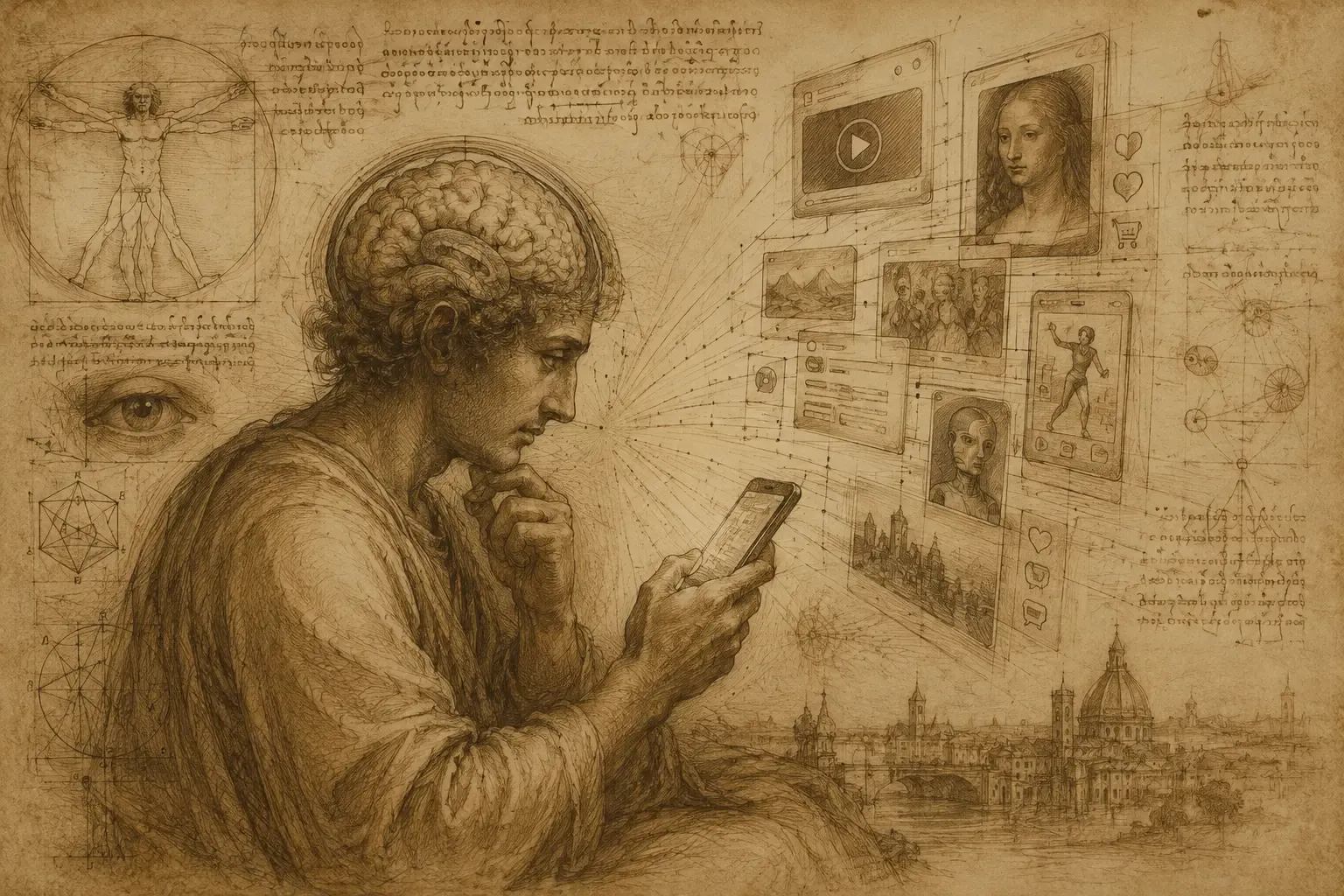
A decade ago, people searched for information.
Today, information searches for people.
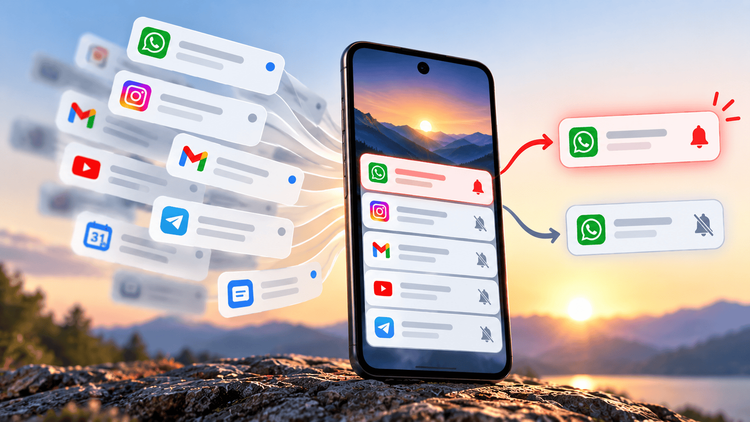
It appears in notifications, reels, swipe cards, AI summaries, YouTube Shorts, carousel posts,and algorithmic feeds. The modern user no longer “reads through” information. They scan, evaluate, react, and move on - often within seconds.
This shift is not just technological. It is cognitive.
The way we consume information today is reshaping how we focus, remember, learn, and make decisions. And if you build products, create content, teach people, or communicate ideas, understanding this shift is no longer optional.
The battle is no longer for information.
It is for attention, retention, and recall.
The Brain Was Never Built for Infinite Scroll
Human cognition evolved in environments with limited stimuli. Today, we live in the opposite condition: endless novelty.
Every scroll introduces a new context:
- ● A political opinion
- ● A meme
- ● A product recommendation
- ● A breaking news alert
- ● A motivational quote
- ● A 15-second educational clip
Our brains constantly switch between contexts without closure.
This matters because working memory - the mental system responsible for temporarily holding and processing information - has limits. Research in cognitive science consistently shows that
humans can only process a small amount of information at once. More recent research suggests the effective capacity may often be around 3–5 chunks of information.
When information arrives too quickly, the brain prioritizes processing speed over deep encoding.
In simple terms:
We become better at consuming information, but worse at storing it.
Consumption Has Become Interface-Driven
Modern platforms are designed around frictionless interaction:
- ● Infinite scrolling
- ● Swipe navigation
- ● Autoplay
- ● Algorithmic recommendations
- ● Short-form video loops
These systems reduce the effort required to consume content. Ironically, reducing effort also reduces cognitive engagement.
Memory science shows that effortful processing improves retention. The harder the brain works to organize, connect, and retrieve information, the more likely it is to remember it later.
But today’s interfaces optimize for continuation, not consolidation.
You are not expected to pause.
You are expected to continue scrolling.
This creates what cognitive scientists call cognitive overload - when incoming information exceeds the processing capacity of working memory.
The result is familiar:
- ● We read more but remember less
- ● We save posts we never revisit
- ● We consume ideas without integrating them
- ● We confuse exposure with understanding
The “Recognition vs Recall” Trap
One of the most important concepts in memory science is the difference between recognition and recall.
Recognition is easy:
“I’ve seen this before.”
Recall is harder:
“Can I explain this without looking?”
Most digital platforms optimize for recognition.
You recognize:
- ● Faces
- ● Formats
- ● Templates
- ● Viral opinions
- ● Familiar hooks
But recognition creates an illusion of learning.
Watching a productivity reel about focus is not the same as building focus. Reading a carousel about negotiation is not the same as being able to negotiate.
Modern information environments often create cognitive familiarity, not cognitive mastery.
That distinction matters enormously for learning.
Why Short-Form Content Feels Addictive
Short-form content works because it aligns with how the brain responds to novelty and reward prediction.
Every swipe carries uncertainty:
- ● Will the next post be funny?
- ● Useful?
- ● Emotional?
- ● Surprising?
This intermittent reward loop keeps attention engaged.
Researchers studying short-form video behavior have linked heavy scrolling and “scroll immersion” with attention difficulties, working-memory disruption, and cognitive fatigue.
But the issue is not that short-form content is inherently harmful.
The issue is frequency without reflection.
The brain needs pauses to consolidate information. Without pauses, experiences remain transient.
Think of it this way:
If the brain is constantly receiving input, it has less opportunity to organize meaning.
The Shift From Deep Attention to Ambient Attention
Earlier forms of media demanded sustained attention.
Books required linear reading.
Long-form articles required patience.
Classrooms required listening.
Now, we consume information in parallel:
- ● Watching while texting
- ● Listening while scrolling
- ● Reading while switching tabs
This creates fragmented attention patterns.
Cognitive load research suggests that constant task-switching and divided attention reduce comprehension and retention.
What emerges is something closer to ambient attention:
a low-intensity, always-on awareness state where users skim information streams instead of deeply engaging with a single idea.
This changes communication itself.
The most effective information today is:
- ● Visually compressed
- ● Emotionally immediate
- ● Contextually familiar
- ● Easy to consume in seconds
That is why:
- ● Carousels outperform essays
- ● Visual explainers outperform text-heavy posts
- ● Hooks matter more than introductions
- ● Formatting influences retention
Information is increasingly competing with interface behavior, not just other information.
But Attention Spans Are Not “Destroyed”
There is a common claim that modern technology has “ruined” human attention spans.
The evidence is more nuanced.
Researchers caution against oversimplifying attention into a single measurable trait. Attention changes depending on motivation, context, emotional relevance, and cognitive demand.
People still binge 8-hour shows, spend hours gaming, and deeply research topics they care about.
The real shift is selective allocation.
Modern users have become ruthless filters.
If content does not signal relevance immediately, it gets skipped.
This means communication today is judged in layers:
- ● 1. Is this worth noticing?
- ● 2. Is this worth continuing?
- ● 3. Is this worth remembering?
- ● 4. Is this worth acting on?
Most content only passes the first test.
What This Means for Learning and Communication
The future of effective communication will not belong to those who create the most information.
It will belong to those who understand cognitive design.
The best communicators today:
- ● Reduce unnecessary cognitive load
- ● Use chunking effectively
- ● Structure information visually
- ● Repeat key ideas strategically
- ● Connect emotion with meaning
- ● Encourage active recall instead of passive consumption
This is why:
- ● Microlearning works
- ● Visual frameworks spread quickly
- ● Interactive learning performs better
- ● AI tutors feel more engaging than static documents
People no longer want information dumps.
They want cognitive clarity.
The Real Question
The internet solved access to information years ago.
Now we face a different challenge:
How do we create information that survives beyond the scroll?
Because in a world where everything competes for attention, the rarest thing is no longer content.
It is meaningful retention.
And the platforms, products, and educators who understand memory - not just media - will shape how the next generation learns.
Sources: