Introduction
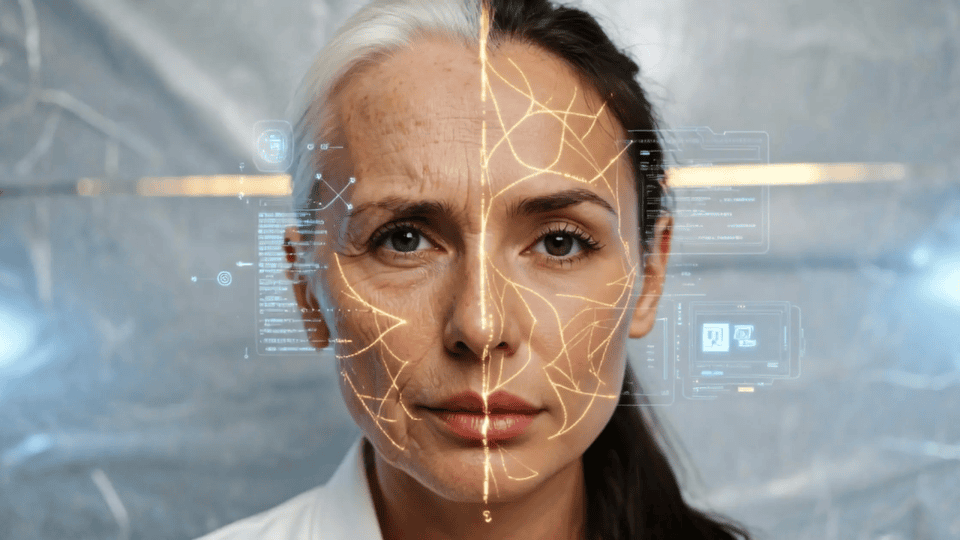
In the digital era, the way people are seen in photos and videos has a huge impact—from memorable movie moments to everyday tools like facial recognition or security checks. Among the most intriguing advances to emerge is de-aging: the art and science of making someone look younger in images and videos.
In the old days, film producers wanted to depend on stand-in actors and makeup artists to make these transformations. But today, studios were emerging into a next-level experience to make de-aging a lifelike experience. AI uses deep learning especially neural networks like Disney’s FRAN made it more practically possible.
What is De-Aging, and Why Does it Matter?
De-aging is the process of an individual where the person’s age is reduced by changing the physical features of the person’s image. It can either be done in image or a video frame.
De-aging has become particularly important in:
- ● Cinema: Allowing actors to convincingly portray younger versions of themselves across different timelines.
- ● Facial recognition systems: Where understanding facial age progression supports security and identity verification.different timelines.
- ● Banking and attendance applications: In which reliable recognition is critical, regardless of age-related changes.
Why does it matter?
Because age plays a central role in perception. Whether for storytelling, identity verification, or personal applications, the ability to alter or understand aging effects on the face helps maintain realism and reliability.
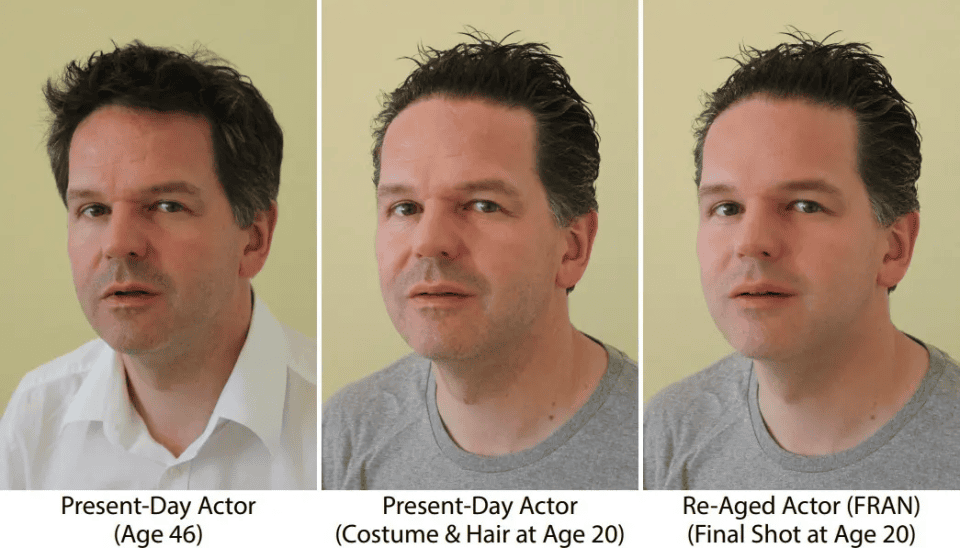
How Was De-Aging Done in the Early Stages of Cinema?
Before the digital revolution, de-aging was achieved mostly through practical techniques:
- ● Body doubles were used in wide shots, especially when showing a younger version of a character and physical makeup helped actors look younger in close-up shots.
- ● After the arrival of Photoshop tools, filmmakers began using the tools and 2D morphing techniques to modify the faces frame by frame. Even though this was an improvement it is a time taking manual effort.
- ● By the 2010s, CG face mapping became the trend. In this process, a stand-in actor performs the scene lively while the actual actor’s face was mapped onto theirs using motion capture technology. A well-known example is the movie called Maattraan which was released in 2012, where actor Suriya played conjoined twins using face replacement technology. Like that motion de-aged model of an actor was created.
- ● Often, filmmakers use hybrid approaches. These methods were effective but costly, slow, and chances of identity loss if not executed carefully.
Why Do We Need an Alternative?
Traditional de-aging methods face several challenges:
1. Takes more time: VFX artists needed to process the workflow frame by frame will take more time.
2. Needs more computational power: Processing high-resolution footage with visual effects takes more resources.
3. Quality issues: Results sometimes suffer from low resolution, blurred details, or identity mismatches.
AI offers a solution by automating much of the process while improving both speed and quality. Neural networks can generate realistic, identity-preserving results with far less manual effort.
How to Do AI De-Aging with Production-Level Quality?
AI-based de-aging has emerged as a faster, more reliable, and scalable method. Here’s how the process works step by step:
1. Gather High-Quality Training Data:
The first step is obtaining datasets of people across different ages. Since collecting longitudinal images of the same individuals over decades is impractical, researchers generate synthetic data using StyleGAN architectures combined with age regressor models.
How it works:
- ● Select an identity in the GAN’s latent space
- ● Adjust the “age attribute” through non-linear paths guided by the regressor.
- ● Produce paired images of the same identity at different ages but under identical conditions (pose, lighting, background). For example, Disney’s FRAN (Face Re-Aging Network) project built a dataset of 2,000 identities, each represented at 14 age stages (18–85 years), resulting in 196,000 training pairs.
2. Formulate the De-Aging Task:
The de-aging problem is modeled as a supervised image-to-image translation task.
Input: The original image plus per-pixel age maps indicating current and desired ages.
Output: A re-aged version of the image that maintains the person’s identity and context.
This formulation provides both global control (overall age) and localized control (specific regions of the face).
3. Train with the Neural Network:
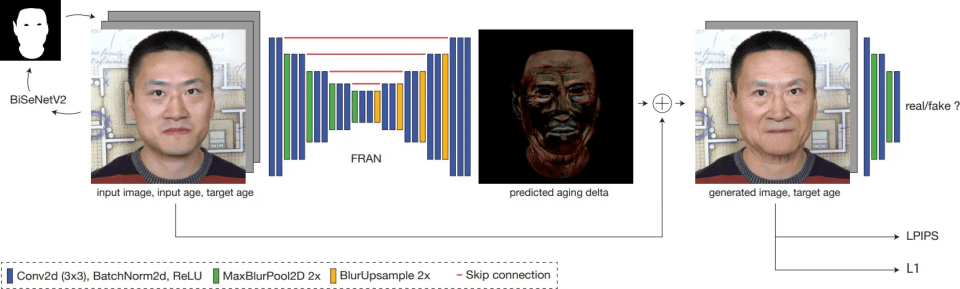
The core engine is FRAN, a U-Net–based convolutional neural network tailored for face re-aging.
Input tensor: A 5-channel matrix (3 RGB channels + current age + target age).
Output: Predicted RGB offsets, applied directly onto the input image.
This is an efficient approach because the model doesn’t regenerate the entire face; it only modifies pixel values where needed, ensuring identity preservation.
4. Segmenting Areas:
To prevent unwanted alterations (e.g., aging the hair or background), FRAN incorporates segmentation masks from pre-trained models like BiSeNetV2.
- ● Segmentation isolates skin regions.
- ● Only those pixels are re-aged.
- ● Ignore hair, eyes, and background
These steps are helping to improve quality and avoid distortion.
5. Tune Loss Functions for Quality:
FRAN optimizes results using three types of loss functions:
- ● L1 Loss: Ensures pixel-level accuracy and smoothness.
- ● LPIPS Perceptual Loss function uses deep VGG features for sharper, perceptually closer results.
- ● Adversarial Loss function uses a discriminator, ensuring outputs look like genuine and real images.
- ● Together, these loss functions balance realism, identity preservation, and convincing age transformation.
6 . Refine Output with Artistic Control:
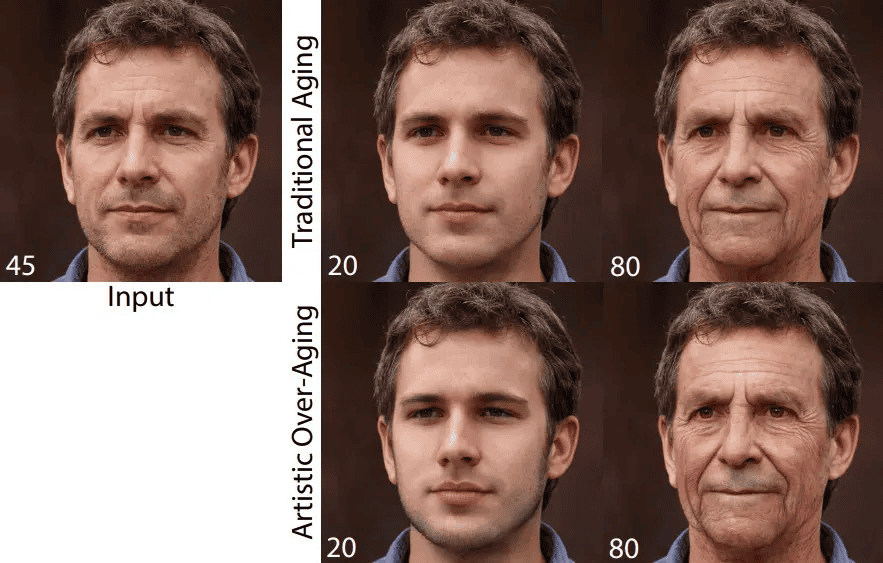
AI provides the technical foundation, but artistic control is still essential for cinema-quality results. With FRAN, artists can:
- ● Adjust target ages precisely.
- ● Modify offsets in specific face regions.
- ● Fine-tune the dramatic or subtle nature of the effect.
This balance of automation and creative input ensures results meet the director’s vision.
7. Review and Finalize the Output:
Artists will review the outputs, and refine, and re-rendered until they align with production needs. While training is a one-time effort, tweaking model parameters and applying artistic control may be repeated several times for best results.
Why is FRAN the Best Choice?
Quantitative evaluations show FRAN outperforms competing methods like LATS, DLFS, HRFAE, and SAM in both identity preservation and aging accuracy.
Lowest identity loss: Minimizes changes to recognizable facial features.
High accuracy: Achieves an age error rate of just 13–21%.
Positive feedback: In user studies, FRAN was consistently rated as delivering the most convincing results.
This makes FRAN a production-ready choice for studios and applications requiring realistic, efficient de-aging.
Tips and Reminders for AI De-Aging:
- ● Get high quality but photorealistic synthetic images for dataset.
- ● Balance automation with artistic input; AI helps in the workflows but doesn’t replace creativity.
- ● Avoid the segmentation in non-facial areas to avoid artifacts.
- ● Use multiple loss functions for a balance of realism and identity preservation.
- ● Iterate de-aging is as much about refining as it is about generating.
Closing:
De-aging using AI paves the way to deliver cinematic quality output with less time. Usage of synthetic datasets and neural networks make the quality best without losing the identical features. This paves the way to the future cinema and delivers the past nostalgia to the audience and ease the filmmakers in the flexibility perspective.
Call-to-Action:
Curious about how AI-driven de-aging can transform your project? Explore the latest tools and research on FRAN and StyleGAN, or consult with VFX and AI specialists to bring production-ready de-aging into your workflow.